Power in Community Knowledge - TSIP’s partnership approach to climate justice
People and nature are interconnected. The relationships we build are invaluable to human connection in which factors such as the environment, civil society and economics impact how we engage with the world around us. Nonetheless, there are growing concerns and complexities about climate change with a wide range of voices engaging in the discussion about how to best tackle the related issues.
However, are these voices representative of those communities and groups across London most affected by climate change?
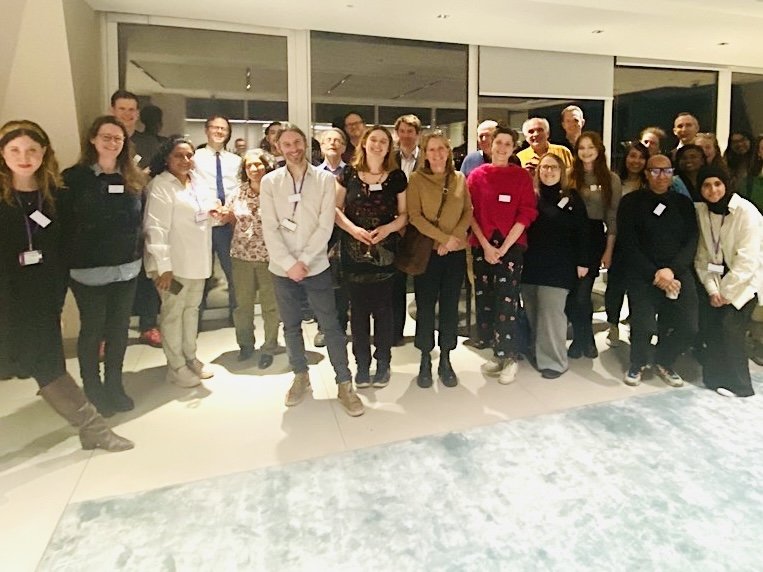
Breathe London Community Programme Event
This is one of our leading questions across our climate focussed projects given the disproportionate impact of climate change on diverse communities who often produce the least amount of air pollution. Our approach to this is grounded in the belief that community assets are valuable - whether through their lived and learnt experiences, testimonies, educational background or simply observation. Increasing participation through capacity building, and the nurturing of these assets, is a significant way to amplify the voices of local individuals, community groups and organisations.
You can read more about our work across climate and environmental justice below. Are you curious to learn more? Get in touch - we’d love to tell you more.
Breathe London
Diversifying the conversation in and around air pollution is at the heart of the Breathe London Community Programme. We began supporting the Breathe London team at Imperial College London on their project in 2023, which looked to sponsor 60 air quality sensors, or nodes, across the city to community groups or organisations. Through capacity building, our role is to facilitate and convene spaces for:
The organisations to connect, network and benefit from shared resources
Amplifying the work of local community organisations seeking to minimise air pollution in their local areas
With the £2.1m extension granted to the programme by the Mayor’s Office and Bloomberg Philanthropies in 2025, we hope to continue capturing insights that reflect the impact of this programme, answer the key learning questions and identify the intrinsic benefits of placing community power at the centre of air quality.
AWAIR
Air pollution isn't just an environmental issue; it's a public health crisis. While people have become more aware of its harm, the actions they can take to protect themselves and their futures are less known about. This information gap is especially concerning considering the disproportionate impact of poor air quality on marginalised communities.
This is where the AWAIR project comes in. Funded by Impact on Urban Health and Hammersmith and Fulham Council, Imperial College partnered with us, Studio Mogla, and On Our Radar to conduct this pioneering study fusing technology, innovation, and co-design to create low-cost outdoor air quality displays to help Lambeth, Southwark, and Hammersmith and Fulham communities see their local air quality in real-time. Our aim is to support community knowledge sharing around air quality, and the health impacts of air pollution, while recommending individual and collective actions to help people reduce air pollution in their communities.
Cultivating Activism Action Fund
Community connecting through amplifying voices is one of the outcomes of our work with Impact on Urban Health, Centric and Science Practice. By working in partnership we look to engage existing air pollution activists and new voices to the climate agenda in Lambeth and Southwark. Through convening spaces where campaigners and activists can deep dive and share their experiences, to explore ways to collaborate we have facilitated capacity building workshops, or AirTables, with the hope to share knowledge and skills across the sector.
We understand that power lies at all levels though there is currently an unequal balance of whose voices get amplified and why. Therefore some of the key questions we ask throughout this project include:
Whose voices are we amplifying, whose are we not and why?
How to bring in the perspectives of voices we are amplifying to make the scoping of any action more credible?
What are we doing to ensure we are not duplicating other amplifying voices' work?
Across these projects, we hope to share further insights towards the recognition that community voice and participation can lead to transformative research and change: systems are made up of people, and can be changed by people.
Curious to learn more about our approach, or how we might be able to support you? Get in touch.